Introduction
Marshall McLuhan's revolutionary theory that "we shape our tools, and they in turn shape us" provides a powerful framework for understanding how media technologies influence human behaviour and cultural development. His assertion that people adapt to their environment through the ratio of senses, resulting in social and cultural change, offers profound insights into contemporary identity formation. This analysis examines McLuhan's technological determinism theory in relation to self-concept development, demonstrating how mediated technologies create new possibilities for identity construction while simultaneously challenging traditional notions of self.
McLuhan's expansion of the concept of "media" beyond traditional communication technologies to include numbers, games, and money reveals his understanding of media as any extension of human capabilities. This broader definition is particularly relevant in our current digital age, where social media platforms, virtual reality environments, and artificial intelligence systems are reshaping how individuals perceive and construct their identities.
McLuhan's Extended Media Theory and Identity Formation
McLuhan's (1964) foundational proposition that mediated technologies ensure culture diffusion in society, which in turn helps change human behaviour, establishes the theoretical groundwork for understanding contemporary identity formation. As TP (2021) notes, McLuhan's unique perspective included numbers, games, and money as forms of media, recognizing that these systems extend human cognitive and social capabilities in ways that fundamentally alter individual and collective identity.
The concept of numbers as media is particularly illuminating when considering how quantification systems influence self-perception. In digital environments, individuals are constantly measured, rated, and ranked through numerical metrics—social media followers, fitness tracking data, credit scores, and performance evaluations. These quantified aspects of identity create what Burrows (2012) terms "metric culture," where numerical representations of self become more significant than qualitative experiences. This phenomenon demonstrates McLuhan's insight that media technologies don't simply transmit information—they fundamentally reshape how individuals understand themselves and their relationships to others.
McLuhan's understanding of games as media of interpersonal communication and extensions of human social self provides crucial insights into contemporary digital identity play. Modern social media platforms function as sophisticated gaming environments where users engage in identity performance, social comparison, and community building. According to Consalvo (2019), digital platforms employ game mechanics such as badges, levels, and rewards to encourage specific behavioural patterns that ultimately serve corporate interests while appearing to empower individual users.
The role of money as empowering media that facilitates access and serves as a transmitter of information, knowledge, and culture aligns with contemporary research on digital divides and algorithmic discrimination. Those with greater financial resources have enhanced access to identity-shaping technologies, educational opportunities, and cultural capital that influence self-concept development. This creates what van Dijck (2013) describes as "data discrimination," where economic status determines not only material opportunities but also the quality and visibility of one's digital identity.
Self-Concept Theory and Media Influence
The self-concept, as defined by McLeod (2021), encompasses how individuals think about, evaluate, and perceive themselves. This cognitive framework is fundamentally shaped by social interactions and cultural contexts, making it particularly susceptible to media influence. The relationship between media consumption and self-concept development has been extensively documented in psychological literature, with researchers consistently finding correlations between media exposure and self-esteem, body image, and social comparison behaviors.
Gibson's (2020) research on social media and identity formation reveals that contemporary individuals engage in what she terms "reflexive self-monitoring," constantly adjusting their self-presentation based on perceived audience feedback. This behavior directly reflects McLuhan's observation that media creates "mass minds" that can be profiled and influenced by elites. However, contemporary digital environments also provide unprecedented opportunities for marginalized communities to construct alternative identities and challenge dominant cultural narratives.
The phenomenon of the "unhappy liar" described in the self-concept improvement essay illustrates how media environments can create psychological distress through constant social comparison and performance pressure. The individual's tendency to base self-worth on others' perceptions reflects the media-saturated environment's emphasis on external validation over internal self-assessment. This pattern aligns with McLuhan's warning about how media technologies can homogenize masses and make them susceptible to elite manipulation.
The Global Village and Identity Fragmentation
McLuhan's concept of the global village, where mediated tools turn the world into an interconnected community, presents both opportunities and challenges for self-concept development. While global connectivity enables individuals to explore diverse identity possibilities and connect with like-minded communities, it also creates unprecedented pressure for identity performance and constant self-presentation.
Recent research by boyd (2014) on digital youth identity demonstrates how social media platforms encourage what she terms "networked publics," where identity formation occurs through continuous performance for imagined audiences. This environment creates what Goffman (1959) originally identified as "impression management," but amplified through digital media's persistence, searchability, and scalability.
The "unhappy liar's" experience of feeling compelled to lie to avoid disapproval reflects the performative pressures of networked identity environments. The individual's ADHD and different work style, combined with social media's emphasis on conformity and popularity, create internal conflicts between authentic self-expression and social acceptance. This tension exemplifies how media technologies can both extend human capabilities and constrain authentic identity development.
Ten Principles for Media-Literate Identity Development
Drawing from both McLuhan's media theory and contemporary research on self-concept development, the following principles offer guidance for navigating identity formation in media-saturated environments:
1. Recognize Media's Shaping Power
Understanding that "we shape our tools, and they in turn shape us" requires critical awareness of how media platforms influence behavior and self-perception. Rather than passively consuming media content, individuals should actively evaluate how different platforms encourage specific identity performances and behavioural patterns.
2. Embrace Digital Identity Play
Following McLuhan's insight about games as extensions of social self, individuals should view digital environments as spaces for identity experimentation and creative expression. However, this play should be conscious and intentional rather than compulsive or anxiety-driven.
3. Develop Media Literacy Skills
Critical evaluation of media messages, understanding of algorithmic curation, and awareness of data collection practices enable more conscious media consumption and identity construction. This literacy serves as a protective factor against manipulative media practices.
4. Balance Quantified and Qualitative Self-Knowledge
While digital metrics provide useful feedback, they should not replace qualitative self-reflection and embodied experience. Maintaining multiple frameworks for self-understanding prevents over-reliance on external validation systems.
5. Cultivate Offline Identity Anchors
Strong offline relationships, physical activities, and face-to-face interactions provide grounding for authentic identity development that is not dependent on digital platform approval or metrics.
6. Practice Selective Media Engagement
Following the advice to avoid negative influences, individuals should consciously curate their media environments to support positive identity development rather than compulsive comparison or performance anxiety.
7. Recognize Economic Dimensions of Identity
Understanding how financial resources influence access to identity-shaping technologies and cultural capital enables more critical engagement with media environments and reduces internalized feelings of inadequacy.
8. Build Supportive Communities
Seeking out communities that support authentic self-expression rather than performative identity aligns with McLuhan's observation about the importance of social context in media effects.
9. Develop Critical Consumption Habits
Being selective about media content, particularly news consumption that emphasizes negative events, supports more balanced self-concept development and reduces anxiety-driven identity behaviors.
10. Embrace Identity Fluidity
Recognizing that identity is constructed through ongoing media engagement rather than fixed essence enables more adaptive and authentic self-development in rapidly changing technological environments.
Freedom Park in Pretoria exemplifies how designed public landscapes began to take on a significant role in attempting to be socially, culturally, and environmentally responsive. The park was conceived as a "people's shrine" where those who endured pain during apartheid would be honored with dignity, symbolizing the joy of freedom and reflecting South Africa's identity. The park's wayfinding and interpretive design systems demonstrate how public design can serve both functional and commemorative purposes, influencing how South African designers approach civic and institutional projects.
Conclusion
Marshall McLuhan's theory that people adapt to their environment through the ratio of senses, resulting in social and cultural change, provides essential insights for understanding contemporary identity formation in media-saturated environments. His recognition that media extends beyond traditional communication technologies to include numbers, games, and money illuminates how contemporary digital environments fundamentally reshape self-concept development through quantification systems, gamified interactions, and economic structures.
The "unhappy liar" case study exemplifies the psychological challenges created by media environments that emphasize external validation over internal self-assessment. However, McLuhan's framework also suggests pathways for more conscious and empowered identity development through critical media engagement, selective participation, and recognition of media's shaping power.
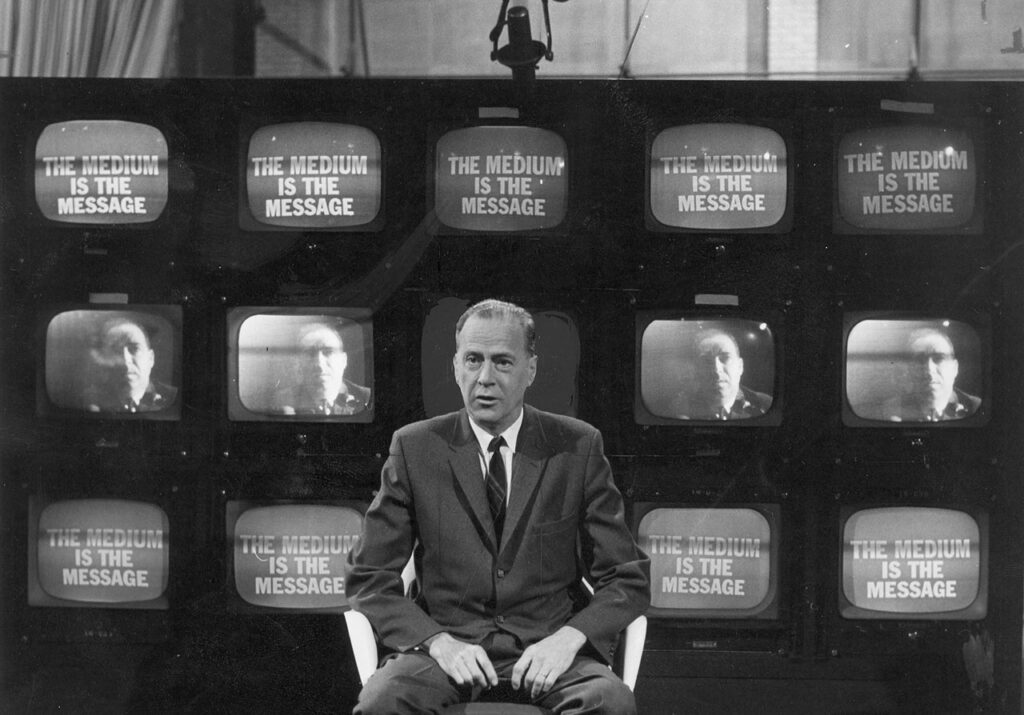
As we navigate increasingly complex media environments, McLuhan's insight that "the medium is the message" reminds us that the technologies we use to construct and express identity are not neutral tools but active shapers of who we become. By developing media literacy, cultivating offline anchors, and practicing conscious identity construction, individuals can harness media's creative potential while maintaining authentic self-concept development.
The global village created by contemporary media technologies offers unprecedented opportunities for identity exploration and community building, but also creates new pressures for performance and conformity. Understanding these dynamics through McLuhan's theoretical framework enables more intentional and empowered engagement with the media environments that increasingly define contemporary identity formation.
References
boyd, d. (2014). It's Complicated: The Social Lives of Networked Teens. Yale University Press.
Burrows, R. (2012). Living with the h-index? Metric culture and reflexive citation practices in the 'academic blogosphere'. Geoforum, 43(2), 284-294.
Consalvo, M. (2019). Video Games and Social Media: Play, Platform, and Power. MIT Press.
Gibson, S. (2020). Digital identity and the reflexive self: Social media and the construction of authentic identity. New Media & Society, 22(4), 643-659.
Goffman, E. (1959). The Presentation of Self in Everyday Life. Doubleday.
McLuhan, M. (1964). Understanding Media: The Extensions of Man. McGraw-Hill.
TP. (2021). MARSHAL MCLUHAN'S TECHNOLOGICAL DETERMINISM THEORY IN THE ARENA OF SOCIAL MEDIA. Theoretical and Practical Research in the Economic Fields, 12(2), 164-171.
van Dijck, J. (2013). The Culture of Connectivity: A Critical History of Social Media. Oxford University Press.
Young, G. and Vosloo, P. (2020). Isivivane, Freedom Park: A critical analysis of the relationship between commemoration, meaning and landscape design in post-apartheid South Africa. Available at: https://doi.org/10.18820/24150487/as27i1.4. [Accessed: 6 June 2023].
Zeitz Museum of Contemporary Art Africa. (n.d.). [Online] Available at: https://zeitzmocaa.museum [Accessed: 6 June 2023].